

Sauces & basics
Injera
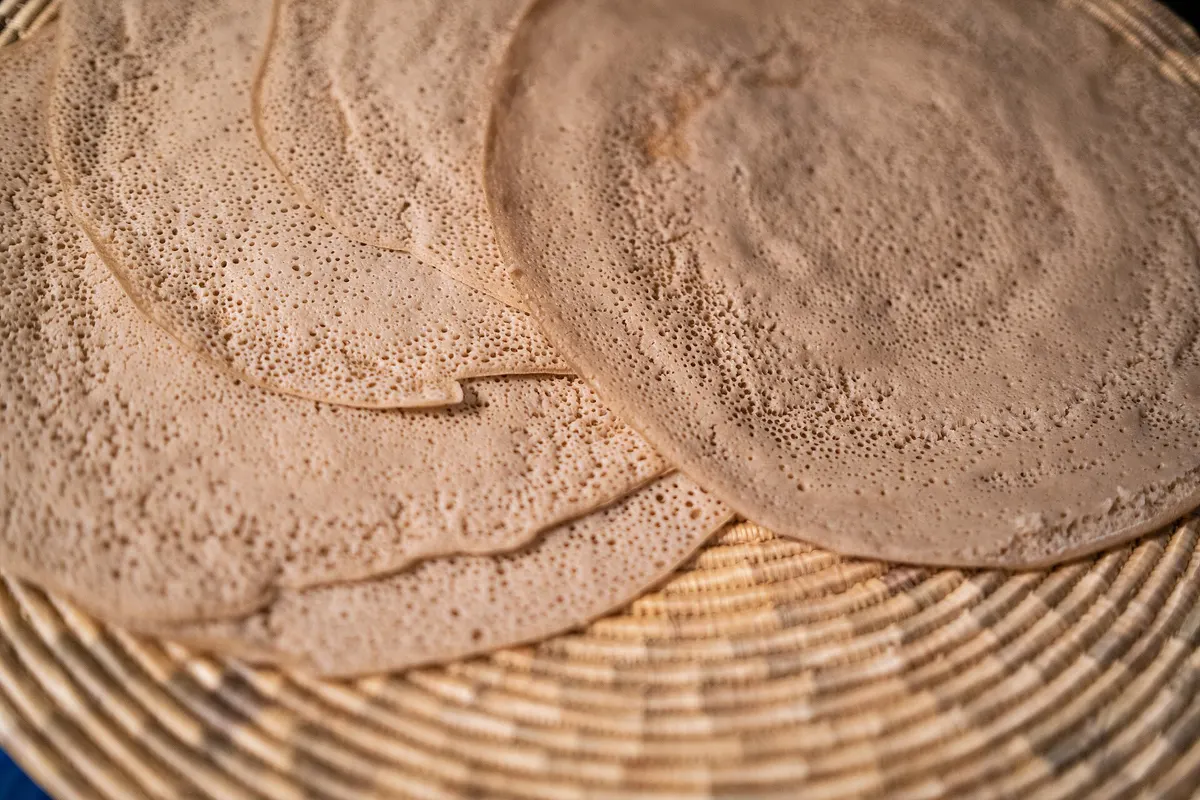
A large, lightly sour, spongy teff flatbread that serves as both plate and utensil. It goes with every Ethiopian meal and is torn by hand to scoop up the dishes.
Ingredients
Ingredients
Spices & seasoning
Nutrition facts
249 kcal per serving
- Protein
- 8.8 g
- Carbohydrates
- 42.4 g
- of which sugars
- 0.9 g
- Fat
- 4 g
- Fiber
- 2.3 g
Ecomely’s estimate, calculated from the ingredients with the ANSES Ciqual food composition table, excluding sides and seasoning added to taste.
Instructions
- In a large bowl, mix the teff flour with the yeast if using, then gradually pour in the warm water while whisking to get a smooth batter as runny as light cream.
- Cover the bowl with a tea towel and let it ferment at room temperature for 2 to 3 days: bubbles will appear on the surface and the batter will smell slightly sour, which means it is ready.
- Before cooking, add the salt and thin the batter with a little water if it is too thick; it should pour easily without being runny.
- Heat a non-stick or cast-iron pan over medium-high heat, lightly brush it with oil and wipe off the excess with kitchen paper.
- Pour a ladleful into the centre and swirl quickly to form an even disc 30 to 40 cm across.
- Cover and cook for 2 to 3 minutes, until holes form on the surface and the edge loosens slightly; there is no need to flip it.
- Slide the injera onto a clean plate, let it cool in the open air so it stays soft, then stack them, separated by a cloth.
Variations and tips
Wheat injera. Replace half the teff with wheat flour (T55) for a softer texture that is easier to get right, without yeast, letting it rest only 12 hours.
More ideas
Berbere (red spice blend)25 min · 8 serv. · budget-friendlyBirtukan (Ethiopian orange juice)10 min · 4 serv. · budget-friendlySpiced coffee-tea (buna shai)20 min · 4 serv. · budget-friendlyAtkilt tibs (Ethiopian vegetable sauté)30 min · 4 serv. · budget-friendlyTeff Porridge with Butter (Yeteff Genfo)20 min · 4 serv. · budget-friendlyFit-fit30 min · 4 serv. · budget-friendlyKitcha25 min · 4 serv. · budget-friendlyAtkilt wat45 min · 4 serv. · budget-friendly
 Ethiopia
 Ethiopia
 Ethiopia
 Ethiopia
 Ethiopia
 Ethiopia
 Ethiopia
 Ethiopia
 Original Ecomely recipe.